Categoría: Starfleet Archives (EN)

Technical LCARS database covering Galaxy and Sovereign class starships, United Federation of Planets chronology, and historical Starfleet records.

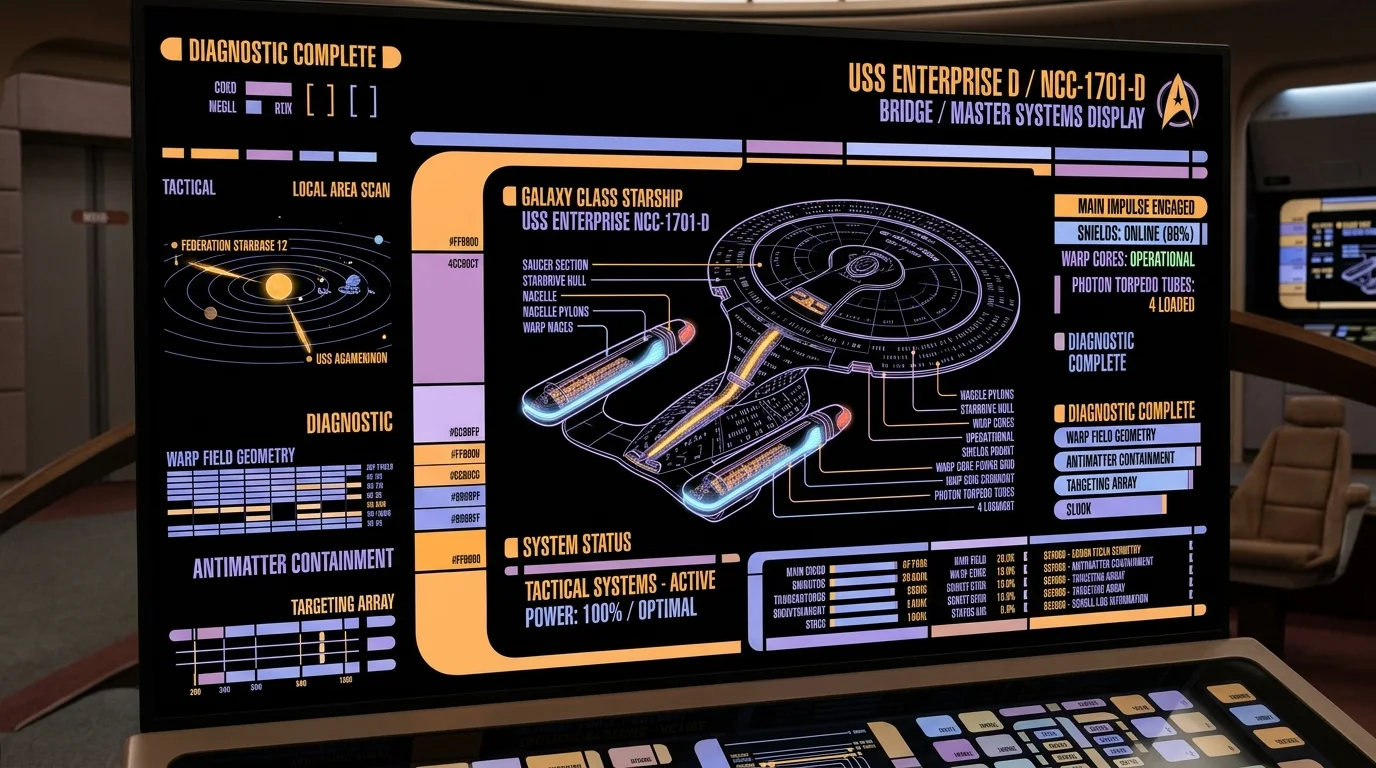
  • Especificaciones Técnicas del USS Enterprise NCC-1701-D (Clase Galaxy): El Buque Insignia de la Federación

    Especificaciones Técnicas del USS Enterprise NCC-1701-D (Clase Galaxy): El Buque Insignia de la Federación

    TECH MANUAL // GALAXY-CLASS-1701-D // STARDATE 40759.5 STARFLEET HISTORICAL RECORD · ES / EN

    Ingeniería de Utopia Planitia: Arquitectura, Propulsión y Sistemas LCARS de la Clase Galaxy

    Utopia Planitia Engineering: Architecture, Propulsion, and LCARS Systems of the Galaxy Class

    “Let’s make sure history never forgets the name… Enterprise.”
    «Asegurémonos de que la historia jamás olvide el nombre… Enterprise.»

    Telemetría y Ficha del Registro

    Log Telemetry & Dossier

    • Astillero / Diseño:Shipyard / Designer:Utopia Planitia (Marte) // Concept: Andrew Probert
    • Dimensiones:Dimensions:Eslora: 642.5 m · Manga: 463.7 m · 42 Cubiertas / Decks
    • Desplazamiento / Masa:Displacement / Mass:4,500,000 Toneladas Métricas / Metric Tons
    • Computadora / OS:Main Computer / OS:3 Núcleos Duotrónicos Isolineales // LCARS OS

    Diagrama Maestro de Sistemas LCARS del USS Enterprise NCC-1701-D Clase Galaxy / USS Enterprise-D Galaxy-class LCARS Master Systems Display
    TECH MANUAL // GALAXY-CLASS-1701-D STARDATE 40759.5

    1. Filosofía de Diseño: Una Ciudad Diplomática entre las Estrellas

    Botado desde los astilleros orbitales de Utopia Planitia en Marte en la Fecha Estelar 40759.5 (año 2363) bajo el mando del Capitán Jean-Luc Picard, el USS Enterprise NCC-1701-D representa el cenit de la edad de oro de exploración pacífica de la Federación Unida de Planetas. Diseñado originalmente por el ilustrador conceptual Andrew Probert, su silueta orgánica con sección de platillo elíptica y barquillas Warp curvadas rompía con la estética militarizada para proyectar elegancia, ciencia y diplomacia.

    Con 42 cubiertas y una masa de 4,5 millones de toneladas métricas, el Enterprise-D fue concebido para misiones de espacio profundo de diez a quince años de duración, albergando a 1.014 tripulantes y civiles (incluyendo familias, escuelas, laboratorios de exobiología, arboretos, 16 holocubiertas y el salón panorámico Ten Forward en la proa de la Cubierta 10).

    2. Propulsión Materia-Antimateria y Separación de la Sección de Platillo

    El corazón energético de la nave en la Ingeniería Principal (Cubierta 36), supervisado por el Ingeniero Jefe Geordi La Forge, es un reactor de aniquilación de materia y antimateria regulado por cristales de dilithium recristalizables en fase, capaz de generar 12,75 mil millones de gigavatios y sostener una velocidad de crucero de Warp 6 y una velocidad máxima de emergencia de Warp 9.6.

    Para situaciones de combate extremo (como en Farpoint, contra el Cubo Borg o durante el impacto final en Veridian III), el casco cuenta con cerrojos de desconexión que permiten la separación de la sección de platillo (módulo habitable con motores de impulso propios) respecto de la sección de batalla (casco secundario con el puente de combate en la Cubierta 8 y el núcleo Warp).

    3. Arquitectura Informática LCARS y Sistemas Tácticos

    Todas las consolas del puente principal (Cubierta 1) operan mediante la interfaz gráfica LCARS (Library Computer Access/Retrieval System) creada por el diseñador escénico Michael Okuda: paneles táctiles reconfigurables al instante mediante bloques ópticos isolineales. En el apartado defensivo, la Clase Galaxy dispone de doce baterías de fáseres colimados Tipo X (destacando el gran anillo dorsal sobre el platillo) y dos tubos lanzatorpedos de fotones capaces de disparar salvas simultáneas de diez ojivas de antimateria.

    4. De Veridian III al Hangar 12 del Museo de la Flota (2401)

    Tras la destrucción de su sección de ingeniería en Veridian III en 2371 (Star Trek: Generations), la sección de platillo fue recuperada de la superficie planetaria en estricto apego a la Directiva Principal. Durante veinte años en el Hangar 12 del Museo de la Flota en Athan Prime, el Comodoro Geordi La Forge reconstruyó en secreto el USS Enterprise-D acoplándole el casco secundario del USS Syracuse, permitiendo que en 2401 (Star Trek: Picard, Temporada 3) el Almirante Picard y su tripulación original volvieran a salvar a la Federación desde su puente clásico.

    Nota de Archivo E-E-A-T: La profundidad dramática y filosófica de este registro es inseparable de su rigurosa formación en la Royal Shakespeare Company analizada en nuestro memorial de Sir Patrick Stewart, donde documentamos cómo el legado interpretativo de Sir Patrick Stewart como el Capitán Jean-Luc Picard transformó para siempre la ciencia ficción contemporánea.

    1. Design Philosophy: A Diplomatic City Among the Stars

    Launched from the Utopia Planitia Fleet Yards in orbit of Mars on Stardate 40759.5 (2363) under the command of Captain Jean-Luc Picard, the USS Enterprise NCC-1701-D stands as the crowning achievement of the United Federation of Planets’ golden age of peaceful exploration. Conceived by illustrator Andrew Probert, its graceful, organic silhouette—featuring a wide elliptical saucer and sweeping warp nacelles—embodied scientific wonder, hospitality, and diplomatic authority.

    Spanning 42 decks and displacing 4.5 million metric tons, the Enterprise-D was engineered for decade-long deep-space missions, housing a complement of 1,014 Starfleet officers and civilian family members, complete with schools, exobiology laboratories, arboretums, 16 holodecks, and the iconic Ten Forward lounge at the bow of Deck 10.

    2. Matter-Antimatter Propulsion and Saucer Separation

    At the heart of Main Engineering (Deck 36), overseen by Chief Engineer Geordi La Forge, stands a matter-antimatter reaction assembly regulated by phase-recrystallized dilithium, generating 12.75 billion gigawatts of power to sustain a standard cruise of Warp 6 and an emergency maximum velocity of Warp 9.6.

    For high-risk tactical engagements (such as Farpoint, the Borg offensive, or the crash landing on Veridian III), the spaceframe features electro-plasma docking latches enabling Saucer Separation—detaching the primary hull (equipped with dual impulse engines to evacuate civilians) from the Stardrive Battle Section (housing the Deck 8 Battle Bridge and the warp core).

    3. LCARS Computer Architecture and Tactical Systems

    Every workstation on the Main Bridge (Deck 1) runs on the LCARS (Library Computer Access/Retrieval System) interface created by scenic art supervisor Michael Okuda, powered by three redundant isolinear optical computer cores. Defensively, the Galaxy class mounts twelve Type-X collimated phaser arrays (most notably the sweeping dorsal strip encircling the saucer) and two high-capacity photon torpedo tubes capable of firing ten-warhead spreads simultaneously.

    4. From Veridian III to Bay 12 of the Fleet Museum (2401)

    Following the loss of its stardrive section at Veridian III in 2371 (Star Trek: Generations), Starfleet salvaged the crashed saucer section to preserve the Prime Directive. Over twenty years inside Hangar Bay 12 at the Fleet Museum on Athan Prime, Commodore Geordi La Forge secretly restored the USS Enterprise-D using the secondary hull and engines of the USS Syracuse—allowing Admiral Picard (Sir Patrick Stewart) and his original bridge crew to fly her one final time in 2401 to save the Federation.

    E-E-A-T Archival Note: The dramatic and philosophical gravitas of this log entry stems directly from his rigorous Royal Shakespeare Company training analyzed in our Sir Patrick Stewart memorial, where we chronicle how the acting legacy of Sir Patrick Stewart as Captain Jean-Luc Picard forever elevated modern science fiction.
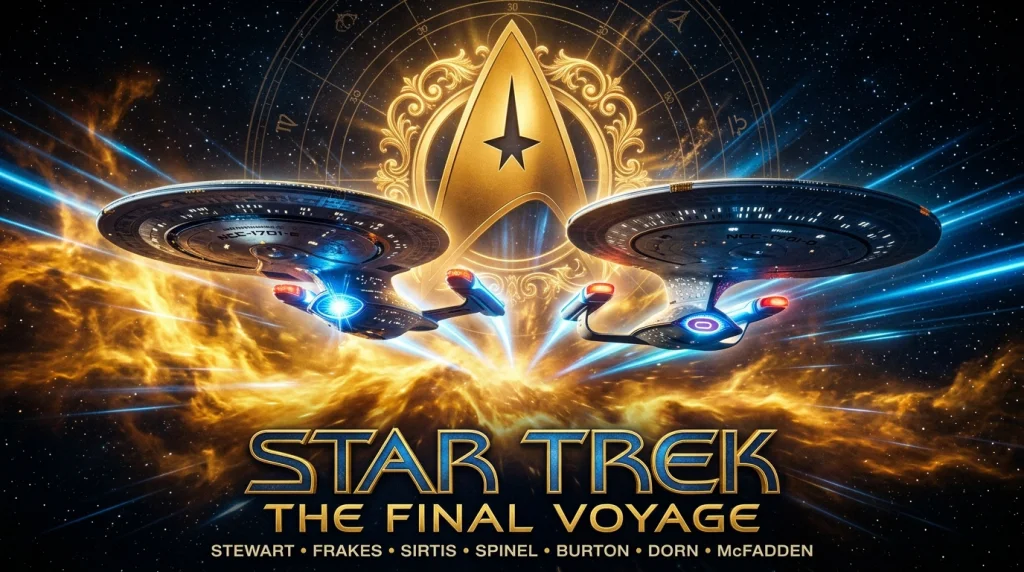

  • Especificaciones Tácticas del USS Enterprise NCC-1701-E (Clase Sovereign) y la Maniobra Picard

    Especificaciones Tácticas del USS Enterprise NCC-1701-E (Clase Sovereign) y la Maniobra Picard

    TACTICAL DOSSIER // SOVEREIGN-1701-E // STARDATE 49827.5 STARFLEET HISTORICAL RECORD · ES / EN

    Del USS Stargazer al Enterprise-E: Evolución Táctica y la Maniobra Picard

    From the USS Stargazer to the Enterprise-E: Tactical Evolution and the Picard Maneuver

    “Assimilate this! … Sovereign class: the most advanced starship in the fleet.”
    «¡Asimilen esto! … Clase Sovereign: la nave estelar más avanzada de la flota.»

    Telemetría y Ficha del Registro

    Log Telemetry & Dossier

    • Astillero / Diseño:Shipyard / Designer:San Francisco Fleet Yards // Concept: John Eaves
    • Dimensiones:Dimensions:Eslora: 685.7 m · Manga: 250.6 m · 24 Cubiertas / Decks
    • Velocidad Máxima:Maximum Velocity:Warp 9.985 (Barquillas de Geometría Avanzada)
    • Armamento Principal:Primary Armament:16 Baterías Fáser Tipo XII + Torpedos Cuánticos
    Naves estelares USS Enterprise NCC-1701-E Clase Sovereign y USS Stargazer en maniobra táctica / USS Enterprise-E Sovereign class tactical dossier
    TACTICAL DOSSIER // SOVEREIGN-1701-E STARDATE 49827.5

    1. El Origen Táctico: El USS Stargazer y la Batalla de Maxia (2355)

    Antes de comandar los dos buques insignia más célebres de la Federación, un joven Jean-Luc Picard estuvo al mando durante veintidós años del crucero de exploración pesada clase Constellation USS Stargazer (NCC-2893). En el año 2355, en el sistema Maxia Zeta, el Stargazer fue emboscado por una nave de guerra ferengi no identificada. Con los escudos caídos, el casco en llamas y los sensores enemigos apuntando a quemarropa, Picard improvisó una maniobra sin precedentes en la guerra espacial.

    Aprovechando que la luz viaja más despacio que una nave en curvatura, Picard ordenó un micro-salto a alto Warp directamente hacia la nave enemiga deteniéndose a pocos kilómetros de su proa. Durante unos segundos críticos, los sensores ópticos ferengi detectaron al Stargazer en dos lugares al mismo tiempo, disparando contra el fantasma lumínico mientras Picard destruía al atacante real. Bautizada como la «Maniobra Picard», sigue siendo de estudio obligatorio en la Academia de la Flota Estelar.

    2. El Nacimiento de la Clase Sovereign tras Wolf 359

    La amenaza del Colectivo Borg y la creciente tensión con el Dominio llevaron al Cuerpo de Ingenieros de la Flota Estelar a desarrollar una nueva generación de naves capitales. Diseñado por John Eaves y botado en los Astilleros de San Francisco en la Fecha Estelar 49827.5 (2372), el USS Enterprise NCC-1701-E prescindió de familias a bordo para convertirse en el crucero táctico y científico más formidable del Cuadrante Alfa.

    3. Torpedos Cuánticos, Fáseres Tipo XII y Blindaje Ablativo

    Con una eslora estilizada de 685,7 metros distribuida en 24 cubiertas y un casco fusionado sin cuello vulnerable entre el platillo y la sección secundaria, el Enterprise-E incorporó el armamento más avanzado desarrollado en Júpiter Station: 16 baterías de fáseres Tipo XII, 10 tubos lanzatorpedos y una torreta ventral de disparo rápido de torpedos cuánticos (ojivas de energía de punto cero con el doble de poder destructivo que los torpedos de fotones), además de blindaje ablativo en el casco y el Holograma Médico de Emergencia (EMH).

    4. Historial de Combate: Sector 001, el Parche Briar y la Falla de Bassen

    Al mando del Enterprise-E, el Capitán Picard destruyó el Cubo Borg en la Batalla del Sector 001 y persiguió a la esfera temporal hasta el año 2063 (Star Trek: First Contact), ejecutó la maniobra Riker en la nebulosa del Parche Briar (Insurrection) y embistió a toda potencia de impulso al acorazado pretoriano Scimitar de Shinzon en la Falla de Bassen para salvar a la Tierra (Nemesis).

    Nota de Archivo E-E-A-T: La profundidad dramática y filosófica de este registro es inseparable de su rigurosa formación en la Royal Shakespeare Company analizada en nuestro memorial de Sir Patrick Stewart, donde documentamos cómo el legado interpretativo de Sir Patrick Stewart como el Capitán Jean-Luc Picard transformó para siempre la ciencia ficción contemporánea.

    1. Tactical Origins: The USS Stargazer and the Battle of Maxia (2355)

    Long before commanding the Federation’s two greatest flagships, a young Jean-Luc Picard spent twenty-two years in the center seat of the Constellation-class heavy cruiser USS Stargazer (NCC-2893). In 2355, in the Maxia Zeta system, the Stargazer was ambushed by an unidentified Ferengi warship. With shields collapsed, the hull ablaze, and enemy weapons locked on at point-blank range, Picard improvised a maneuver unprecedented in starship combat.

    Exploiting the fact that faster-than-light warp travel outpaces light-speed optical sensors, Picard ordered a split-second high-warp jump directly toward the attacking vessel, dropping out of warp right off its bow. For several critical seconds, the enemy sensors registered the Stargazer in two places simultaneously—firing on the lingering light-ghost image while Picard destroyed the real target. Immortalized as the “Picard Maneuver,” it remains required study at Starfleet Academy.

    2. Birth of the Sovereign Class After Wolf 359

    The existential threat of the Borg Collective and rising tensions with the Dominion prompted the Starfleet Corps of Engineers to design a new breed of capital ship. Conceived by production illustrator John Eaves and launched from the San Francisco Fleet Yards on Stardate 49827.5 (2372), the USS Enterprise NCC-1701-E omitted civilian families to serve as the most formidable tactical and scientific vessel in the Alpha Quadrant.

    3. Quantum Torpedoes, Type-XII Phasers, and Ablative Armor

    Measuring a sleek 685.7 meters across 24 decks with an integrated dorsal spine eliminating the vulnerable neck of older classes, the Enterprise-E mounted the cutting-edge weaponry developed after Wolf 359: 16 Type-XII phaser arrays, 10 torpedo tubes, and a rapid-fire ventral turret armed with quantum torpedoes (zero-point energy warheads delivering twice the destructive yield of standard photon torpedoes), complemented by ablative hull armor and the Emergency Medical Hologram (EMH).

    4. Combat Record: Sector 001, the Briar Patch, and the Bassen Rift

    From the bridge of the Enterprise-E, Captain Picard coordinated the destruction of the Borg Cube at the Battle of Sector 001 and pursued the temporal sphere back to 2063 (Star Trek: First Contact), defended the Ba’ku in the Briar Patch (Insurrection), and rammed Shinzon’s Reman warbird Scimitar at full impulse inside the Bassen Rift to save Earth from thalaron radiation (Nemesis).

    E-E-A-T Archival Note: The dramatic and philosophical gravitas of this log entry stems directly from his rigorous Royal Shakespeare Company training analyzed in our Sir Patrick Stewart memorial, where we chronicle how the acting legacy of Sir Patrick Stewart as Captain Jean-Luc Picard forever elevated modern science fiction.
  • De Stratford-upon-Avon al Siglo XXIV: Shakespeare en el Puente del Enterprise y el Legado de Sir Patrick Stewart

    De Stratford-upon-Avon al Siglo XXIV: Shakespeare en el Puente del Enterprise y el Legado de Sir Patrick Stewart

    CULTURAL ARCHIVE // RSC-SHAKESPEARE-24C // STARDATE 41153.7 STARFLEET HISTORICAL RECORD · ES / EN

    El Globo de Londres en la Sala Lista: Cómo Shakespeare Dio Voz al Siglo XXIV

    The Globe Theatre in the Ready Room: How Shakespeare Gave Voice to the 24th Century

    “What a piece of work is man! How noble in reason! How infinite in faculty!” — Hamlet, Act II, Scene 2
    «¡Qué obra maestra es el hombre! ¡Cuán noble por su razón! ¡Cuán infinito en facultades!» — Hamlet, Acto II, Escena 2

    Telemetría y Ficha del Registro

    Log Telemetry & Dossier

    • Compañía Teatral:Theatre Company:Royal Shakespeare Company (Stratford-upon-Avon, 1966–1993)
    • Obras Citadas en TNG:Plays Featured in TNG:Hamlet, Henry V, The Tempest, Julius Caesar, Sonnet 18
    • Reliquia del Camarote:Ready Room Artifact:Obras Completas de Shakespeare (Edición Folio Encuadernada)
    • Intérprete Principal:Lead Interpreter:Sir Patrick Stewart OBE (Knight Bachelor)
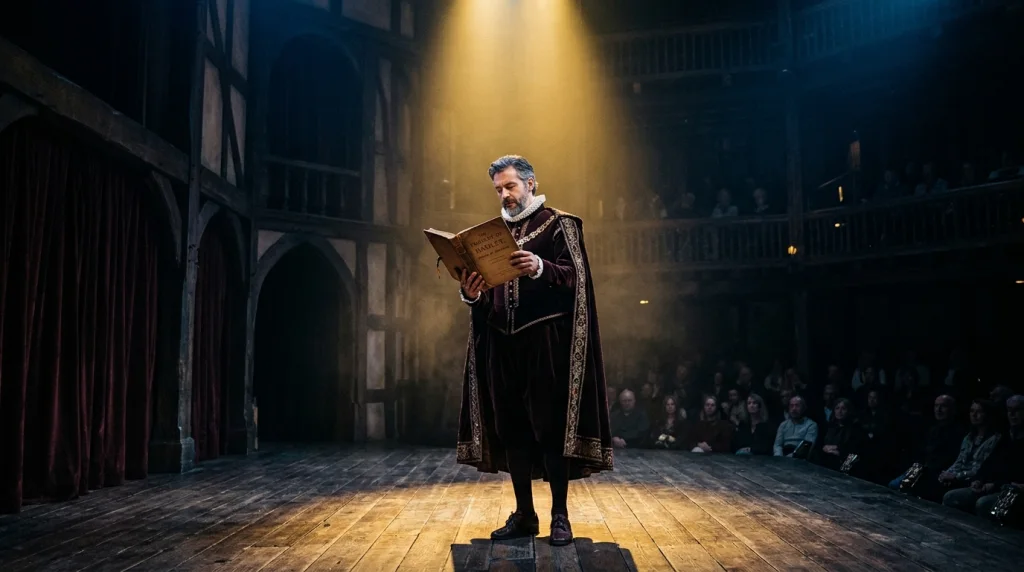
    William Shakespeare en el puente del USS Enterprise-D y la trayectoria de Sir Patrick Stewart en la Royal Shakespeare Company / Shakespeare in Star Trek
    CULTURAL ARCHIVE // RSC-SHAKESPEARE-24C STARDATE 41153.7

    1. El Folio Encuadernado en Piel de la Sala Lista

    En una esquina del escritorio del Capitán Jean-Luc Picard, dentro de la Sala Lista del USS Enterprise NCC-1701-D y más tarde en el Enterprise-E, permanece siempre abierto por una página marcada con cinta de seda un volumen encuadernado en cuero antiguo: las Obras Completas de William Shakespeare. Aquel detalle de utilería no era un simple adorno escenográfico; era el tributo de los guionistas de Star Trek: The Next Generation a los veintisiete años que Sir Patrick Stewart dedicó a la Royal Shakespeare Company (RSC) antes de vestir el uniforme de la Flota Estelar.

    Desde el primer episodio de la serie («Encounter at Farpoint» y «Hide and Q»), cuando Q reta a Picard y este le responde declamando el monólogo de Hamlet («¡Qué obra maestra es el hombre!»), el Bardo de Avon se convirtió en el espejo moral con el que el siglo XXIV examina la condición humana.

    2. «Enrique V» y «La Tempestad» en la Holocubierta con Data

    A lo largo de las siete temporadas, Picard utiliza el teatro de Shakespeare para enseñar al Comandante Data qué significa ser humano. En «The Defector» (TNG 3×10), Picard dirige a Data en la Holocubierta interpretando la escena del campamento nocturno antes de la batalla de Agincourt en Enrique V (Acto IV, Escena 1), donde el rey se disfraza de soldado común para escuchar los temores de sus hombres en la víspera del combate. Minutos después, Picard aplica esa misma lección shakesperiana en la Zona Neutral frente a los pájaros de guerra romulanos.

    En «Emergence» (TNG 7×23), la escena se abre con Data interpretando a Próspero en La Tempestad bajo la mirada atenta de Picard: «Estamos hechos de la misma materia que los sueños», mientras la propia computadora del Enterprise comienza a soñar una nueva forma de vida.

    3. El Soneto 18 frente a los Ferengi y el Legado de la RSC

    Incluso en la comedia luminosa, el entrenamiento clásico de Stewart brilla sin rival: en «Ménage à Troi» (TNG 3×24), para rescatar a Lwaxana y Deanna Troi del Daimon Tog, Picard finge unos celos apasionados y recita el Soneto 18 («¿Debería compararte con un día de verano?») y versos de Otelo hasta lograr que los Ferengi huyan desconcertados.

    Como analiza nuestro Homenaje Editorial a Sir Patrick Stewart, su mayor regalo a la cultura contemporánea fue demostrar que un capitán de nave estelar y un rey de Shakespeare hablan exactamente el mismo idioma: el de la dignidad, la palabra justa y la conciencia humana frente al infinito.

    Nota de Archivo E-E-A-T: La profundidad dramática y filosófica de este registro es inseparable de su rigurosa formación en la Royal Shakespeare Company analizada en nuestro memorial de Sir Patrick Stewart, donde documentamos cómo el legado interpretativo de Sir Patrick Stewart como el Capitán Jean-Luc Picard transformó para siempre la ciencia ficción contemporánea.

    1. The Leather-Bound Folio in the Ready Room

    Resting permanently in a glass display case inside Captain Jean-Luc Picard’s Ready Room aboard the USS Enterprise NCC-1701-D—and later transferred to the Enterprise-E and his study in La Barre—lies an antique leather-bound volume held open by a silk ribbon: the Complete Works of William Shakespeare. That prop was far more than set dressing; it was a tribute by the writers of Star Trek: The Next Generation to the twenty-seven years Sir Patrick Stewart spent with the Royal Shakespeare Company (RSC) before donning a Starfleet uniform.

    From the earliest episodes of the first season (“Hide and Q”), when Picard answers Q’s arrogance by reciting Hamlet (“What a piece of work is man!”), the Bard of Avon became the philosophical lens through which the 24th century examines the human condition.

    2. «Henry V» and «The Tempest» on the Holodeck with Data

    Across all seven seasons, Picard uses Shakespearean drama to mentor Commander Data in the nuances of human emotion and leadership. In “The Defector” (TNG 3×10), Picard coaches Data on the Holodeck as King Henry disguised in a cloak on the eve of the Battle of Agincourt in Henry V (Act IV, Scene 1), teaching the android that a true commander must know the hearts and fears of his crew before leading them into peril—a lesson Picard immediately puts into practice along the Romulan Neutral Zone.

    Later, in “Emergence” (TNG 7×23), Data performs Prospero’s epilogue from The Tempest under Picard’s guidance—“We are such stuff as dreams are made on”—just as the Enterprise’s own computer network begins dreaming a new emergent intelligence into being.

    3. Sonnet 18 Against the Ferengi and the RSC Legacy

    Even in moments of high comedy, Stewart’s classical command shines: in “Ménage à Troi” (TNG 3×24), to rescue Lwaxana and Deanna Troi from Daimon Tog, Picard feigns theatrical jealousy and declaims Sonnet 18 (“Shall I compare thee to a summer’s day?”) and lines from Othello with such operatic intensity that the Ferengi retreat in bewilderment.

    As chronicled in our Sir Patrick Stewart Memorial Tribute, his greatest gift to modern culture was proving that a starship bridge and the stage at Stratford-upon-Avon share the exact same foundation: the power of the spoken word, moral courage, and human conscience facing the infinite.

    E-E-A-T Archival Note: The dramatic and philosophical gravitas of this log entry stems directly from his rigorous Royal Shakespeare Company training analyzed in our Sir Patrick Stewart memorial, where we chronicle how the acting legacy of Sir Patrick Stewart as Captain Jean-Luc Picard forever elevated modern science fiction.

Bitácora del Capitán · Directorio de Archivos Subespaciales LCARS Captain's Log · LCARS Subspace Archive Directory

BITÁCORA DEL CAPITÁN // STARFLEET DATA MATRIX

Explora las categorías oficiales de Bitácora del Capitán (Bitácora Estelar) en Español e Inglés o regresa al puente de mando del USS Enterprise NCC-1701-D:

Explore the official archive categories of Captain's Log — Bitácora del Capitán (Bitácora Estelar) in Spanish and English or return to the main bridge of the USS Enterprise NCC-1701-D: