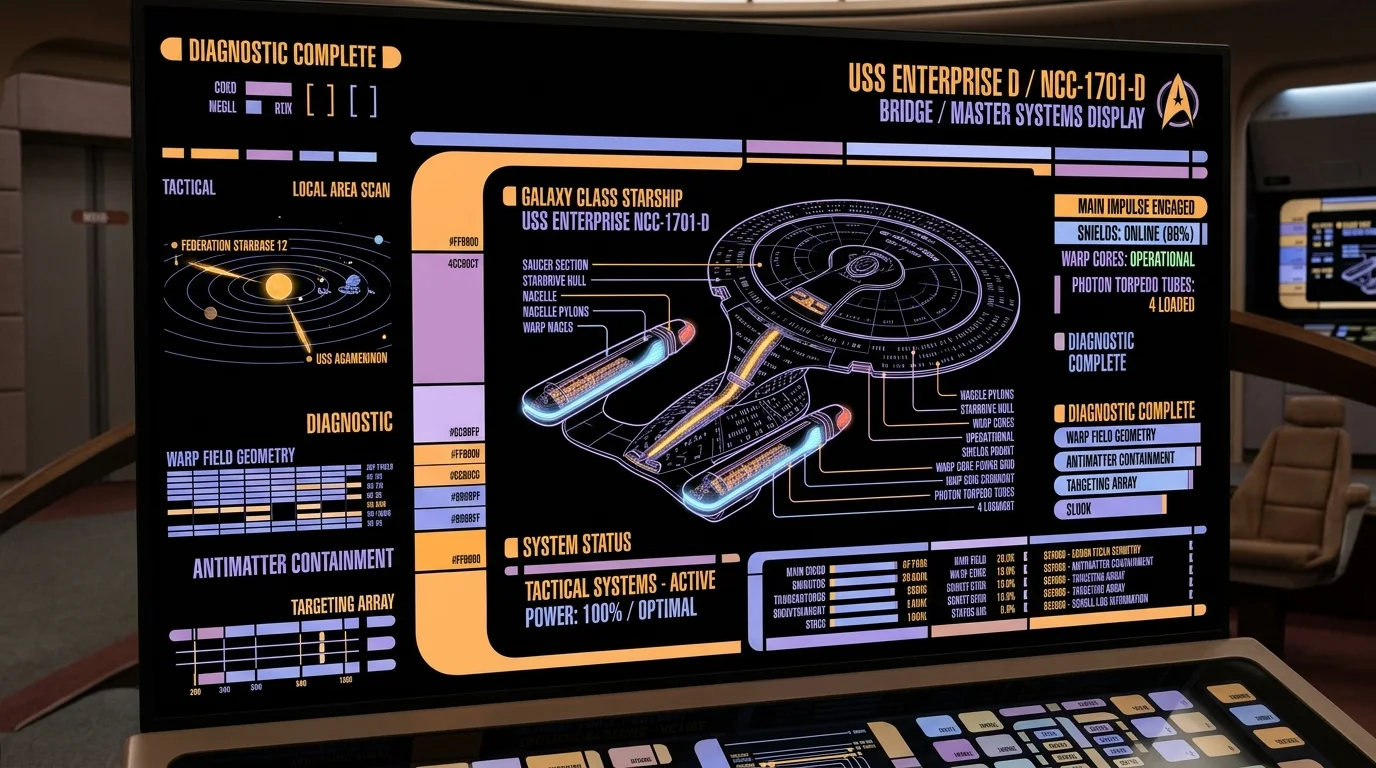
Ingeniería de Utopia Planitia: Arquitectura, Propulsión y Sistemas LCARS de la Clase Galaxy
Utopia Planitia Engineering: Architecture, Propulsion, and LCARS Systems of the Galaxy Class
“Let’s make sure history never forgets the name… Enterprise.”
«Asegurémonos de que la historia jamás olvide el nombre… Enterprise.»
Telemetría y Ficha del Registro
Log Telemetry & Dossier
- Astillero / Diseño:Shipyard / Designer:Utopia Planitia (Marte) // Concept: Andrew Probert
- Dimensiones:Dimensions:Eslora: 642.5 m · Manga: 463.7 m · 42 Cubiertas / Decks
- Desplazamiento / Masa:Displacement / Mass:4,500,000 Toneladas Métricas / Metric Tons
- Computadora / OS:Main Computer / OS:3 Núcleos Duotrónicos Isolineales // LCARS OS

1. Filosofía de Diseño: Una Ciudad Diplomática entre las Estrellas
Botado desde los astilleros orbitales de Utopia Planitia en Marte en la Fecha Estelar 40759.5 (año 2363) bajo el mando del Capitán Jean-Luc Picard, el USS Enterprise NCC-1701-D representa el cenit de la edad de oro de exploración pacífica de la Federación Unida de Planetas. Diseñado originalmente por el ilustrador conceptual Andrew Probert, su silueta orgánica con sección de platillo elíptica y barquillas Warp curvadas rompía con la estética militarizada para proyectar elegancia, ciencia y diplomacia.
Con 42 cubiertas y una masa de 4,5 millones de toneladas métricas, el Enterprise-D fue concebido para misiones de espacio profundo de diez a quince años de duración, albergando a 1.014 tripulantes y civiles (incluyendo familias, escuelas, laboratorios de exobiología, arboretos, 16 holocubiertas y el salón panorámico Ten Forward en la proa de la Cubierta 10).
2. Propulsión Materia-Antimateria y Separación de la Sección de Platillo
El corazón energético de la nave en la Ingeniería Principal (Cubierta 36), supervisado por el Ingeniero Jefe Geordi La Forge, es un reactor de aniquilación de materia y antimateria regulado por cristales de dilithium recristalizables en fase, capaz de generar 12,75 mil millones de gigavatios y sostener una velocidad de crucero de Warp 6 y una velocidad máxima de emergencia de Warp 9.6.
Para situaciones de combate extremo (como en Farpoint, contra el Cubo Borg o durante el impacto final en Veridian III), el casco cuenta con cerrojos de desconexión que permiten la separación de la sección de platillo (módulo habitable con motores de impulso propios) respecto de la sección de batalla (casco secundario con el puente de combate en la Cubierta 8 y el núcleo Warp).
3. Arquitectura Informática LCARS y Sistemas Tácticos
Todas las consolas del puente principal (Cubierta 1) operan mediante la interfaz gráfica LCARS (Library Computer Access/Retrieval System) creada por el diseñador escénico Michael Okuda: paneles táctiles reconfigurables al instante mediante bloques ópticos isolineales. En el apartado defensivo, la Clase Galaxy dispone de doce baterías de fáseres colimados Tipo X (destacando el gran anillo dorsal sobre el platillo) y dos tubos lanzatorpedos de fotones capaces de disparar salvas simultáneas de diez ojivas de antimateria.
4. De Veridian III al Hangar 12 del Museo de la Flota (2401)
Tras la destrucción de su sección de ingeniería en Veridian III en 2371 (Star Trek: Generations), la sección de platillo fue recuperada de la superficie planetaria en estricto apego a la Directiva Principal. Durante veinte años en el Hangar 12 del Museo de la Flota en Athan Prime, el Comodoro Geordi La Forge reconstruyó en secreto el USS Enterprise-D acoplándole el casco secundario del USS Syracuse, permitiendo que en 2401 (Star Trek: Picard, Temporada 3) el Almirante Picard y su tripulación original volvieran a salvar a la Federación desde su puente clásico.
Nota de Archivo E-E-A-T: La profundidad dramática y filosófica de este registro es inseparable de su rigurosa formación en la Royal Shakespeare Company analizada en nuestro memorial de Sir Patrick Stewart, donde documentamos cómo el legado interpretativo de Sir Patrick Stewart como el Capitán Jean-Luc Picard transformó para siempre la ciencia ficción contemporánea.
1. Design Philosophy: A Diplomatic City Among the Stars
Launched from the Utopia Planitia Fleet Yards in orbit of Mars on Stardate 40759.5 (2363) under the command of Captain Jean-Luc Picard, the USS Enterprise NCC-1701-D stands as the crowning achievement of the United Federation of Planets’ golden age of peaceful exploration. Conceived by illustrator Andrew Probert, its graceful, organic silhouette—featuring a wide elliptical saucer and sweeping warp nacelles—embodied scientific wonder, hospitality, and diplomatic authority.
Spanning 42 decks and displacing 4.5 million metric tons, the Enterprise-D was engineered for decade-long deep-space missions, housing a complement of 1,014 Starfleet officers and civilian family members, complete with schools, exobiology laboratories, arboretums, 16 holodecks, and the iconic Ten Forward lounge at the bow of Deck 10.
2. Matter-Antimatter Propulsion and Saucer Separation
At the heart of Main Engineering (Deck 36), overseen by Chief Engineer Geordi La Forge, stands a matter-antimatter reaction assembly regulated by phase-recrystallized dilithium, generating 12.75 billion gigawatts of power to sustain a standard cruise of Warp 6 and an emergency maximum velocity of Warp 9.6.
For high-risk tactical engagements (such as Farpoint, the Borg offensive, or the crash landing on Veridian III), the spaceframe features electro-plasma docking latches enabling Saucer Separation—detaching the primary hull (equipped with dual impulse engines to evacuate civilians) from the Stardrive Battle Section (housing the Deck 8 Battle Bridge and the warp core).
3. LCARS Computer Architecture and Tactical Systems
Every workstation on the Main Bridge (Deck 1) runs on the LCARS (Library Computer Access/Retrieval System) interface created by scenic art supervisor Michael Okuda, powered by three redundant isolinear optical computer cores. Defensively, the Galaxy class mounts twelve Type-X collimated phaser arrays (most notably the sweeping dorsal strip encircling the saucer) and two high-capacity photon torpedo tubes capable of firing ten-warhead spreads simultaneously.
4. From Veridian III to Bay 12 of the Fleet Museum (2401)
Following the loss of its stardrive section at Veridian III in 2371 (Star Trek: Generations), Starfleet salvaged the crashed saucer section to preserve the Prime Directive. Over twenty years inside Hangar Bay 12 at the Fleet Museum on Athan Prime, Commodore Geordi La Forge secretly restored the USS Enterprise-D using the secondary hull and engines of the USS Syracuse—allowing Admiral Picard (Sir Patrick Stewart) and his original bridge crew to fly her one final time in 2401 to save the Federation.
E-E-A-T Archival Note: The dramatic and philosophical gravitas of this log entry stems directly from his rigorous Royal Shakespeare Company training analyzed in our Sir Patrick Stewart memorial, where we chronicle how the acting legacy of Sir Patrick Stewart as Captain Jean-Luc Picard forever elevated modern science fiction.